Nobody grows up dreaming about flexographic printing. And yet almost everything in your fridge, your medicine cabinet, and your warehouse got its label from a flexo press. When manufacturers like Domino Foods, Lipo Chemicals, and American Sugar Refining need tens of thousands of labels produced consistently, accurately, and on schedule, this is the technology doing the heavy lifting — and it’s been our primary production method at Certified Labeling Solutions since 1986.
TL;DR
Flexo uses flexible printing plates to lay down one color per station at very high speed, on almost any material — paper, films, foils, you name it. It costs a bit to set up (plates and dies), then gets dramatically cheaper per label the more you print. Rule of thumb: 5,000+ labels, flexo wins. Short runs and variable data, digital wins. We run both.
What Is Flexographic Printing?
Flexography (“flexo” to its friends) is a modern descendant of letterpress printing. Instead of rigid metal type, it uses flexible relief plates — think of an extremely precise, extremely fast rubber stamp — to transfer ink onto virtually any substrate.
That “any substrate” part is the superpower. Offset lithography wants a flat, well-behaved surface, ideally paper. Flexo shrugs and prints on plastics, metallic films, cellophane, polypropylene, polyester, and paper alike. That’s why it’s the dominant label printing method worldwide, and why it serves industries as different as food, pharma, logistics, and chemicals without breaking a sweat.
How the Flexo Process Works
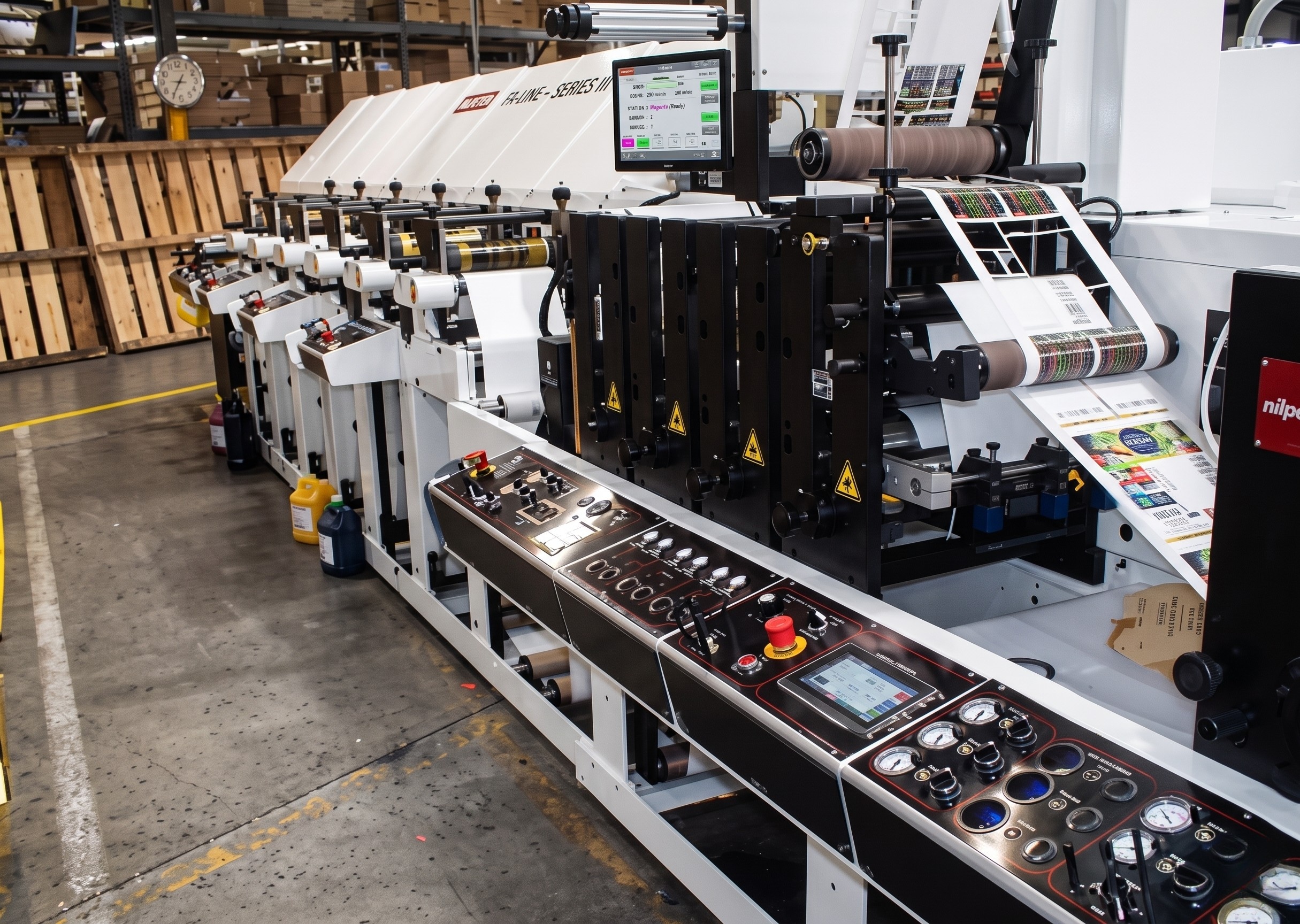
Your label material moves through a series of printing stations — one per ink color. At each station, a small relay race happens in a fraction of a second:
The fountain roller sits in the ink pan and picks up ink continuously.
The anilox roller — the unsung hero of flexo — takes ink from the fountain roller. Its surface is engraved with a precise pattern of microscopic cells that meter out an exact amount of ink, every rotation, all shift long. This is the secret to flexo’s color consistency across long runs.
A doctor blade scrapes off the excess, leaving only the metered ink in the cells. (No medical degree involved — it “doctors” the ink film.)
The plate cylinder holds the flexible polymer plate carrying your artwork. It picks up ink from the anilox and stamps it onto the substrate.
The impression cylinder provides backing pressure so the transfer is clean and crisp.
A label with six spot colors passes through six of these stations before it’s done. Blink and you missed all of it.
Why should you care about an anilox roller? Because it's the reason label #48,000 looks identical to label #1. When a printer can't explain how they keep color consistent, the anilox is the part they're fuzzy on.
The Tooling: What It Costs and Why It’s Worth It
“Tooling” is everything physical that has to exist before your job can run. It’s also the part of the quote that generates the most questions — tap any item for the honest breakdown:
Plates — the part you buy once
Flexible polymer sheets, one per color, laser-imaged from your artwork. Modern photopolymer plates hold exceptional detail and last for millions of impressions. You buy them once; they keep working.
Dies — often free, thanks to our library
After printing, labels get cut to their final shape, and the die is the precision tool that does it. Here’s the good news: we maintain thousands of dies in stock, so many common label sizes require zero new tooling investment from you. You only pay for a die if your shape is genuinely custom.
Anilox & fountain rollers — our problem, not yours
Press components, not job-specific — but selecting the right anilox cell volume for your ink and substrate is part of the setup craft.
Doctor blades — consumables (our cost)
Replaced regularly so the ink metering stays precise. You’ll never see these on an invoice.
The tooling math is simple: the upfront cost gets spread across every label you print. At 500 labels it stings. At 50,000 it’s a rounding error.
Flexo vs. Digital: When to Choose Which
Both have a job to do, and we run both. Try it yourself:
How many labels do you need per run?
That's flexo territory. Tooling cost spreads across the run, per-label price drops, and color stays locked run after run. Get a flexo quote →
Digital is your friend here — no plates, no dies, fast turnaround. Great for testing designs before committing to tooling. See digital & variable data →
The honest answer: it depends on your substrate, finishes, and reorder pattern. This is exactly the 10-minute conversation we do for free — send us your specs and we'll run the math both ways.
Prefer the full picture? Here’s the honest decision table:
Your situation
Better fit
5,000+ labels per run
Flexo
Under 2,000 labels
Digital
Specialty substrates (films, foil, thermal)
Flexo
Every label needs different data (serial numbers, barcodes)
For a lot of manufacturers the real answer is both: digital for short runs and variable data, flexo for the production volumes. That’s not a compromise — that’s using each press for what it’s actually good at.
The Result: Precision at Scale
Done right, flexo delivers color accuracy that rivals offset litho, with substrate flexibility nothing else matches. Our PMS-matched ink blending means the color on your label matches your brand standard run after run, year after year — no “close enough.”
That’s been the standard here since 1986, and it’s why manufacturers across New Jersey, New York, and Pennsylvania trust us with the labels their production lines depend on.
Ready to talk through your next label run? Call (908) 495-6235 or request a quote — we’ll review your artwork, recommend the right substrate and finish, and deliver labels that work as hard as your business does.
Frequently asked questions
What is flexographic printing?
Flexographic printing, or flexo, is a high-speed printing method that uses flexible relief plates, similar to a very precise rubber stamp, to transfer ink onto a substrate one color per station. A modern descendant of letterpress, it prints on paper, plastics, cellophane, polypropylene, and polyester alike, which is why it is the dominant label printing method worldwide across the food, pharmaceutical, logistics, and chemical industries.
How does a flexographic press apply ink?
Each color runs through its own printing station. A fountain roller picks up ink, an anilox roller engraved with microscopic cells meters out an exact amount, a doctor blade scrapes away the excess, and a plate cylinder carrying the flexible polymer plate stamps the ink onto the material while an impression cylinder provides backing pressure. A six-color label passes through six of these stations, each in a fraction of a second.
What is an anilox roller and why does it matter?
The anilox roller is the ink-metering heart of a flexographic press. Its surface is engraved with a precise pattern of microscopic cells that deliver an exact amount of ink on every rotation, all shift long. That metering is the reason color stays consistent across long runs, so label 48,000 looks identical to label 1.
What tooling do I need to pay for on a flexographic label job?
The main tooling items are printing plates and cutting dies. Plates are flexible polymer sheets, one per color, laser-imaged from your artwork; you buy them once and they last for millions of impressions. Dies cut labels to their final shape, and Certified Labeling Solutions keeps thousands of dies in stock, so many common label sizes require no new tooling. Press components like anilox rollers and doctor blades are the printer's cost, not yours.
When should I choose flexo over digital label printing?
Choose flexo for runs of roughly 5,000 labels or more, specialty substrates like films and thermal stocks, specialty finishes such as lamination and backside printing, and the lowest possible cost per label. Choose digital for runs under about 2,000 labels, jobs where every label carries different data, testing a new design before committing to tooling, or very tight deadlines. Many manufacturers use both: digital for short runs, flexo for production volume.
Why does flexo get cheaper per label at higher quantities?
The tooling and setup for a flexographic job cost the same whether you print 500 labels or 50,000, so that upfront cost is spread across every label in the run. At small quantities it dominates the price of each label; at production volumes it becomes a rounding error. That is why flexo wins on cost per label once volume climbs.
Labels giving you a headache?
Send us a sample, artwork, or just your specs — we'll quote it fast. Manufacturing in Hillsborough, NJ since 1986, shipping nationwide.