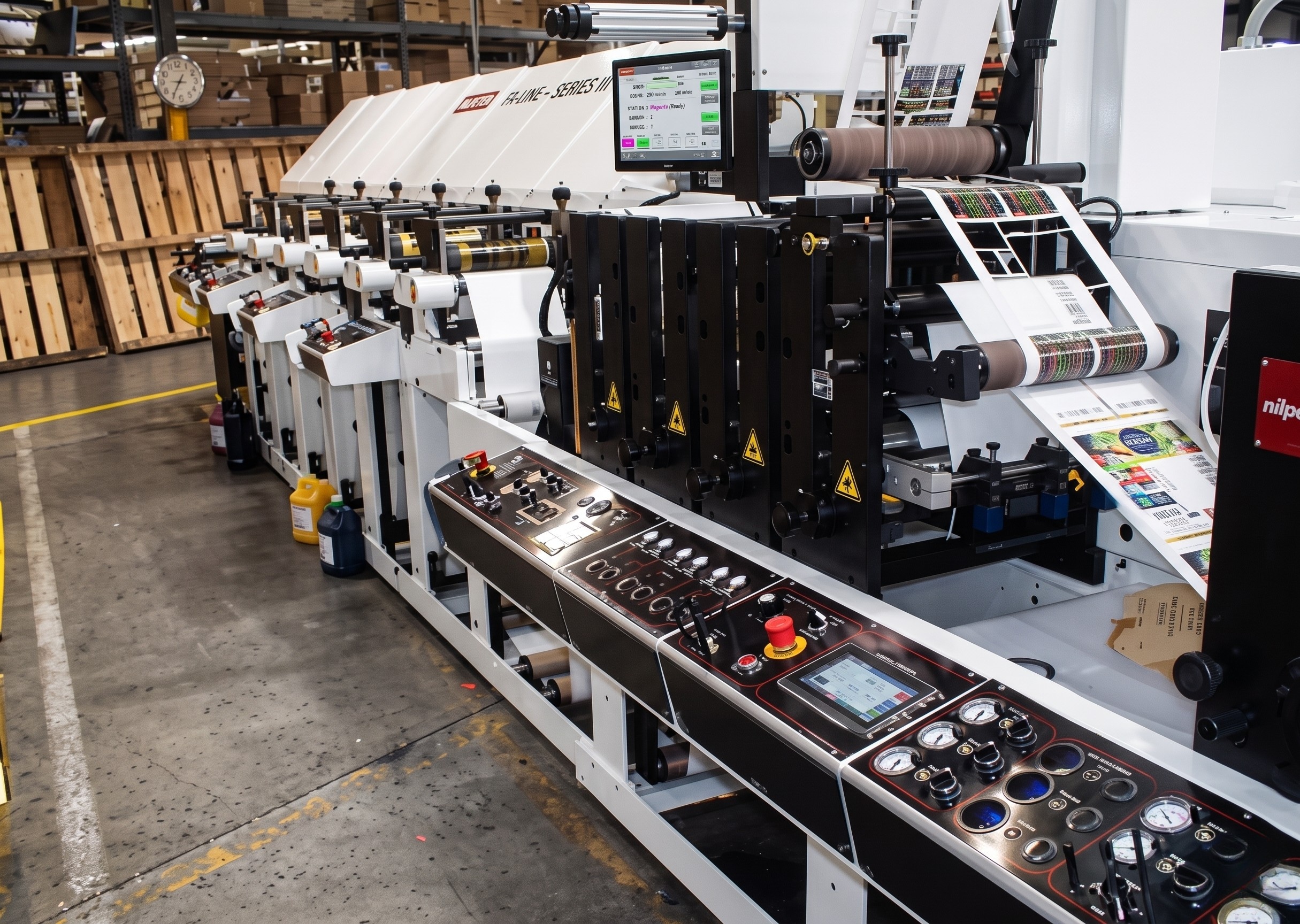
Pick up almost any labeled product near you — the bottle, the box, the drum, the pill bottle — and there’s a very good chance its label came off a flexographic press. It’s the workhorse of the label world, and it’s the machine your labels run on when you order from us. So here’s a plain look at what a flexo press actually is, what’s on our floor in Hillsborough, and why the box matters as much as the artwork you feed into it.
TL;DR
A flexographic press prints your label by transferring ink through a flexible relief plate, one color per station, at high speed on a continuous roll — then cures, die-cuts, and rewinds it in the same pass. We run four: a Nilpeter 13” 7-color (our flagship), a Nilpeter 11” 6-color, a Roto 16” 4-color wide-format, and an Allied Gear 10” with inline overlaminating. Every press also runs inline video inspection that looks at every single label, not a sample.
How a Flexographic Press Works
Strip away the branding and every flexo press does the same thing: it moves a roll of label stock past a line of printing stations, one per color, and lays down ink in a fraction of a second at each one. Here’s the relay race happening inside:
- Ink supply. Each color station holds its own ink. It’s pumped from a reservoir into the inking system for that station.
- Anilox roller. This is the heart of flexo. It’s a metal or ceramic roller engraved with millions of microscopic cells, each holding a precise, metered volume of ink. Cell volume is measured in BCM (billion cubic microns), and it’s what sets the ink film thickness — same amount, every rotation, all shift long.
- Doctor blade. A thin blade wipes the excess ink off the anilox, leaving only what’s held in the cells. The anilox-and-doctor-blade pairing is why flexo meters ink so consistently regardless of how fast the press is running.
- Plate cylinder and flexo plate. A photopolymer plate carrying your artwork mounts on the plate cylinder. Its raised areas pick up ink from the anilox and stamp it onto the substrate. Every color gets its own plate.
- Impression cylinder. Your label stock passes between the plate and the impression cylinder, which applies controlled backing pressure so the ink transfers cleanly and evenly.
- UV curing. UV lamps flash-cure the ink instantly — no smearing, no waiting to dry. UV-curable inks also leave a harder, more chemically resistant print surface than solvent or water-based inks.
- Die cutting. A rotary die — a machined steel cylinder with cutting rules in your label’s exact outline — cuts the printed labels to shape inline, stripping away the waste web.
- Rewind. Finished labels wind back onto cores in roll format, ready to ship or apply.
Printing, curing, die-cutting, rewinding — all of it happens in one continuous pass. Blink and a few hundred labels have already gone by.
Why the anilox matters to you: it's the reason label #40,000 looks identical to label #1. When a printer can't clearly explain how they hold color across a long run, the anilox is usually the part they're fuzzy on.
What Makes Nilpeter the Benchmark
Nilpeter is a Danish press manufacturer founded in 1919, and among commercial label printers its narrow- and mid-web flexo presses are widely regarded as the benchmark for print quality and mechanical precision. That reputation isn’t marketing — it comes down to a few things that are hard to see and easy to feel in the finished label.
Registration precision
Registration is how tightly each color station lines up with the others. On a 7-color job, all seven layers have to stack precisely — miss by fractions of a millimeter and you get visible color fringing or blur. Nilpeter’s mechanical design and servo-driven registration systems hold tighter registration than lower-cost press platforms, and they hold it across the run.
Impression control
Consistent impression pressure drives both consistent ink transfer and clean die cutting. Nilpeter’s impression control keeps tight tolerances across the full print width and from the start of a run to the end of it.
Inline UV curing
Nilpeter presses build UV curing units in between (or after) each color station. Curing inline is what lets you print on non-absorbent substrates — BOPP, polyester, foil — that wet inks would smear on, and it leaves a harder, more chemically resistant surface.
Stability at speed
A press that holds registration at a crawl but drifts at production speed isn’t a production press. Nilpeter equipment stays on spec at real running speeds, which is exactly what long runs and high-volume programs demand.
Our Equipment: What’s on the Production Floor
Certified Labeling Solutions runs four production presses in Hillsborough, NJ. Here’s the lineup and what each one is for:
| Press | Print width | Colors | Standout capability |
|---|
| Nilpeter (flagship) | 13” | 7-color + UV | Full CMYK plus spot colors, or up to seven Pantone spot colors, plus overprint varnish — in a single pass |
| Nilpeter | 11” | 6-color + UV | Medium-complexity programs; same substrate and adhesive range as the 13” |
| Roto | 16” | 4-color | Wide-format work — extended content labels, large industrial and food-service labels |
| Allied Gear | 10” | 5-color | Inline overlaminating station for scratch, chemical, and outdoor durability |
A few notes worth pulling out of the table:
- The Nilpeter 13” 7-color is our flagship. Seven stations plus UV curing means fluorescent inks and exact Pantone spot colors can all land in one run — no secondary passes. Thirteen inches of print width covers the vast majority of label sizes used in food, beverage, pharma, and industrial markets.
- The Allied Gear 10” finishes as it prints. Overlaminating lays a clear protective film over the printed label in the same pass, so labels that need to survive scuffing, chemical splash, or the outdoors come off the press already protected.
Good to know — every label gets looked at. All four presses run inline video web inspection: a camera system scans every label at full production speed and flags print defects, missing labels, and die-cut issues in real time for the operator to address. Defective labels are marked for removal before finishing. This isn't spot-checking a sample — it's every label on the roll.
What This Means for Your Labels
The equipment is only interesting because of what it does for the labels in your hand:
- Color you can trust across runs. Nilpeter’s mechanical precision holds color and registration from the first label to the last — and from one reorder to the next. Your 10,000th label matches your 100th.
- Substrate range. Paper, BOPP, polyester, vinyl, specialty films — if your application calls for it, we can run it.
- Brand color in one pass. Seven-color capability means fluorescents and exact PMS spot colors reproduce without secondary operations tacked onto the schedule.
- Defects caught at the press. Inline inspection means problems get flagged before the roll ships, not after it lands on your line.
The press is the foundation of label quality, which is why we’ve built our floor around Nilpeter production equipment. The labels we make carry our customers’ brands and their compliance obligations — food manufacturers, pharmaceutical companies, industrial producers — and that’s not the place for “close enough.”
Want to talk through what your labels would run on? Call (908) 495-6235 or request a quote, and we’ll match your artwork, substrate, and finish to the right press.