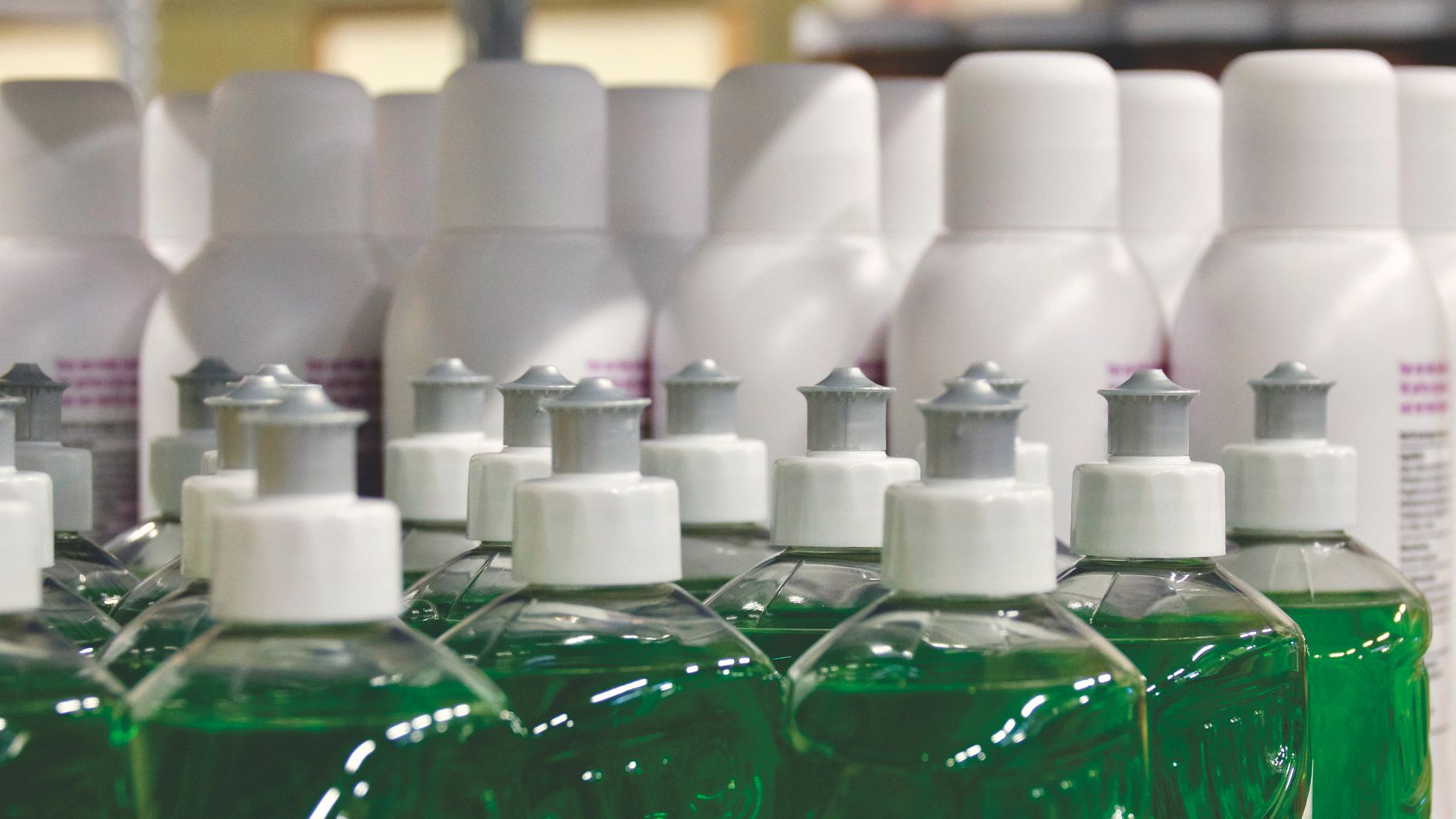
Walk down any grocery aisle and you’re looking at two different labeling technologies pretending to be the same thing. Some products wear a printed film that hugs every curve, top to bottom. Others wear a flat label stuck to one face. The first is a shrink sleeve; the second is a pressure-sensitive (PS) label — and the gap between them is bigger than it looks.
We’re a pressure-sensitive label manufacturer, so we’ll tell you up front where our bias sits. But we’d rather you pick the right construction than the one we happen to run — so here’s the honest version.
Pressure-sensitive labels are the right call for most products: they're faster, cheaper at nearly every volume, work on almost any container, and don't lock you into a specific bottle shape. Shrink sleeves earn their premium when you need full 360° graphics, coverage of a complex contour, or a tamper-evident band built into the wrap. If your product is a standard bottle, jar, or box and you want brand-accurate color without retooling, PS wins on cost and flexibility.
What each one actually is
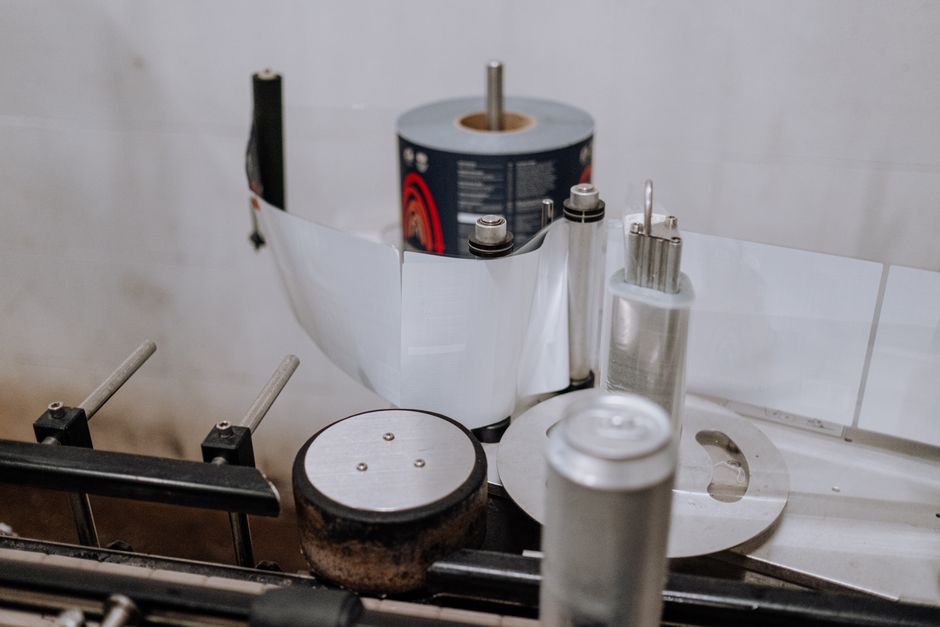
A pressure-sensitive label is printed on a face material (paper or film), coated with adhesive, die-cut to shape, and applied to the container. It’s the sticker construction you already know — but engineered: the face stock, adhesive, and finish are all chosen for the surface and the environment.
A shrink sleeve is a printed plastic tube. It’s slipped over the container and passed through a heat or steam tunnel, where it shrinks tight to the shape — wrapping the whole body, including compound curves a flat label can’t follow.
Head to head
Tap each option to see what it is, what it’s best at, and its trade-off.
A printed film tube shrunk tight to the container — full, seamless 360° coverage.
Best for
Full-body graphics with no seam showing on the shelf face
Contoured or odd-shaped containers a flat label can't follow
A tamper band built right into the wrap
The trade-off
Tooling, distortion-corrected art prep, and a sleeving line add cost — and the plastic sleeve can complicate recycling the container underneath.
A die-cut adhesive label applied to the container — the shelf default, and usually the smarter one.
Best for
Lower cost at almost any volume — short runs and long ones alike
Any container (glass, PET, HDPE, metal, pouches), and switching bottles anytime
Fast reprints, a clear "no-label look," and recycle-friendly constructions
The trade-off
Covers one or two faces rather than wrapping the whole body in a single seamless piece.
Most products answer their way to pressure-sensitive — the sleeve earns its premium only when the graphic physically has to wrap a shape a flat label can’t.
A useful rule of thumb: if your reason for wanting a sleeve is "it looks premium," a well-specced pressure-sensitive label with a soft-touch laminate, a spot gloss, or a spot-UV accent usually gets you there for less — without the retooling. If your reason is "the art physically has to wrap a shape a flat label can't handle," that's a genuine sleeve job.
The cost and speed picture
Shrink sleeves front-load cost: tooling, distortion-correcting art prep, and the sleeving/tunnel step. That math can work at very high, stable volumes with a fixed container. Pressure-sensitive stays lean across short runs and long ones, reprints fast when your art changes, and doesn’t care if you tweak the bottle next season. (For how pressure-sensitive pricing actually breaks down, see our guide to what custom labels cost.)
For most food, beverage, supplement, and personal-care brands moving at NJ/NY/PA volumes, that flexibility is worth more than full-body coverage — which is why the shelf is still mostly pressure-sensitive.
Still not sure?
Which best describes your product?
That's a genuine shrink-sleeve job — full-body coverage of a contour is the one thing a flat label can't match. Worth the tooling if the shape and volume are locked in.
Pressure-sensitive, almost certainly. You get brand-accurate PMS color, lower cost, and the freedom to change containers later — done right, with the material and finish matched to the job. Request a sample →
Go pressure-sensitive and stay flexible. PS reprints fast and doesn't lock you into one bottle shape, so you can iterate without re-tooling. Request a sample →
Not sure which construction your product needs? Send us your container and artwork and we’ll give you a straight answer — and a pressure-sensitive sample built to your spec so you can see it on the shelf. Call (908) 495-6235 or request a sample.
Frequently asked questions
What is the difference between a shrink sleeve and a pressure-sensitive label?
A shrink sleeve is a printed plastic film tube slipped over the container and heat-shrunk to wrap it 360 degrees, top to bottom. A pressure-sensitive label is a die-cut adhesive label applied to one or two faces of the container. Sleeves suit full-body graphics and odd shapes; pressure-sensitive labels suit most standard containers at lower cost.
Which is cheaper, shrink sleeves or pressure-sensitive labels?
Pressure-sensitive labels are almost always cheaper per unit, and they skip the tooling and heat-tunnel setup that shrink sleeves require. Shrink sleeves carry a higher per-unit cost plus custom tooling fees, so they usually pay off only at high, stable volumes or when full-body coverage is essential.
Are shrink sleeve labels recyclable?
It depends on the sleeve material. PETG sleeves that meet APR recycling guidance can pass through the PET stream, but PVC sleeves contaminate PET recycling, and a full-body sleeve can cause a container to be sorted out by a recycler's optical scanner. A pressure-sensitive label with a recycle-compatible facestock and a wash-off adhesive keeps the container in the recycling stream.
Can you put a shrink sleeve on any container shape?
Shrink sleeves conform to almost any shape — tapers, hourglass curves, and compound contours — because they shrink to the container. Pressure-sensitive labels work best on flat or gently curved surfaces; tight compound curves can wrinkle or lift a flat label.
What is the minimum order quantity for shrink sleeves vs. pressure-sensitive labels?
Shrink sleeve minimums commonly start around 5,000 per design because of the custom sizing and tooling. Pressure-sensitive labels are more flexible for short runs — flexographic runs generally start in the low thousands, and digital printing handles shorter runs cost-effectively.
Do shrink sleeves provide tamper evidence?
Yes. A shrink sleeve can extend over the cap or lid as a tamper-evident band in the same piece, which is useful for food, beverage, and pharmaceutical products. A pressure-sensitive label needs a separate tamper seal added.
Which has faster turnaround, shrink sleeves or pressure-sensitive labels?
Pressure-sensitive is generally faster and reprints quickly when your artwork changes. Shrink sleeves take longer because each design needs custom sizing and tooling before the sleeving and heat-tunnel steps.
Labels giving you a headache?
Send us a sample, artwork, or just your specs — we'll quote it fast. Manufacturing in Hillsborough, NJ since 1986, shipping nationwide.